


 JA
JA
TOPICS & NEWS
2026.01.26
KDDI, one of Japan’s leading telecommunications giants, officially commenced operations at its newly established “Osaka Sakai Data Center” on January 22, 2026. This launch marks a significant turning point for the company’s data center (DC) business. After several years without major new facilities, KDDI is pivoting aggressively to capture the surging demand for AI processing power. This move is seen as a tactical masterstroke, positioning KDDI at the heart of Japan’s evolving AI infrastructure landscape.
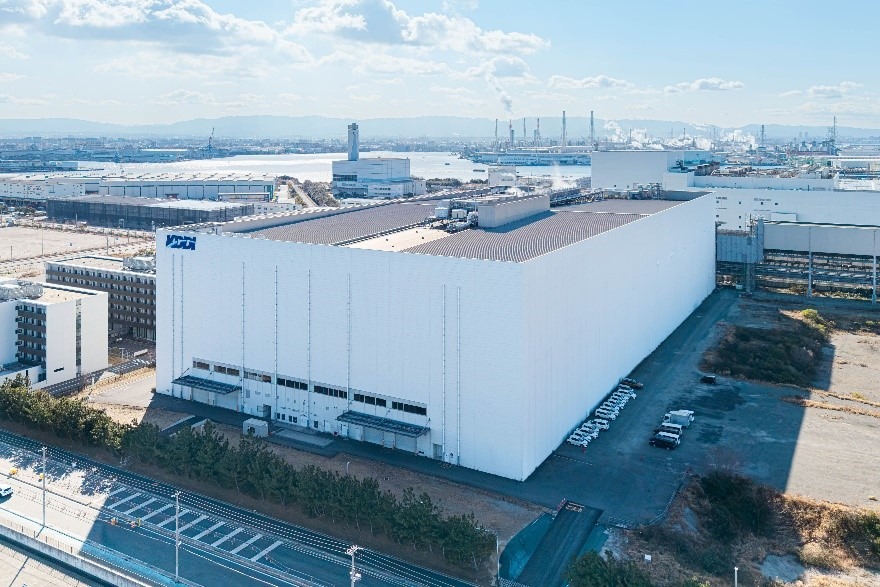
Sakai Data Center, Osaka
Rapid Deployment via Site Repurposing
The Osaka Sakai Data Center is situated on the former site of Sharp’s Sakai plant, which KDDI acquired in April 2025. By leveraging the site’s pre-existing, large-scale power and cooling infrastructure, KDDI achieved an exceptionally fast turnaround, launching operations in just about six months. This speed-to-market provides a distinct competitive advantage over rivals facing long lead times for traditional DC construction.
The facility spans four floors with a total floor area of approximately 57,000 square meters. Notably, it is designed for sustainability, powered by 100% renewable energy. To handle high-density computing while maintaining energy efficiency, the center employs Direct Liquid Cooling (DLC) technology.
Optimized for the AI Era
The center is purpose-built for the AI revolution. It houses latest-generation GPU servers, including the NVIDIA GB200 NVL72, optimizing it for both AI training and inference. Furthermore, KDDI plans to use the site as a collaborative hub, offering on-premise deployments of Google’s “Gemini” generative AI models through strategic partnerships.
For enterprise clients, the facility will provide on-demand GPU resources, supporting the social implementation of AI across various sectors. KDDI aims to meet the growing hunger for high-performance computing in data-heavy industries such as pharmaceuticals and manufacturing.
A Legacy of Expertise in a Changing Landscape
KDDI is not starting from scratch; the design and operation of the Osaka Sakai facility integrate over 30 years of expertise, including water-cooling technologies perfected at its Telehouse Shibuya location. This allows the company to balance high availability and stability with the flexibility required for emerging technologies.
The broader trend in Japan shows a resurgence of domestic investment. With SoftBank also advancing large-scale DC projects at former factory sites, it is clear that data centers have transcended their role as mere “telecom infrastructure” to become the essential digital backbone for all industries.
Global Entry and the Shifting Market Dynamics (Global Perspective)
While domestic giants like KDDI and SoftBank are scaling up, the Japanese market is increasingly becoming a magnet for international operators and infrastructure funds. Following in the footsteps of UK-based Colt Data Centre Services, we are seeing a new wave of global players. For instance, Actis recently launched “Epoch Digital,” a specialized platform targeting data center expansion across Asia, including Japan.
Fuelled by AI and cloud demand, investment interest is expanding beyond the Greater Tokyo Area into the Kansai region and core regional cities where power availability and land potential are more favorable.
For international players looking to enter or expand in Japan, success hinges on navigating unique local challenges: securing power allocations, site selection, regulatory coordination, and understanding regional nuances. In this complex environment, specialized organizations like the Digital Infrastructure Lab (DIL)—which focuses on data center site discovery and suitability assessment—will play a pivotal role in bridging the gap between global capital and Japanese infrastructure opportunities.


dil_admin
TOPICS & NEWS
Related Post

Japan’s GX Strategy Enters Implementation Phase: ~90 Expressions of Interest Received in Initial Call

At the Intersection of Power Infrastructure and Digital Foundations

SoftBank Accelerates Data Center Strategy for the AI Era — Pioneering the Future of Digital Society through Infrastructure Innovation —
Goodman Accelerates Data Center Development Across Japan

Review of the 2025 Data Center Market: A Year Defined by Diverse Players and Dynamic Growth

Data Center Construction Costs: A New Focal Point in the Generative AI Era
Latest News